
Welcome
Workplace Integration System™
Awareness is only the beginning.
Many organisations have already invested in neurodiversity awareness, policies and workplace adjustments.
Yet managers can still feel uncertain.
Employees may still struggle to access support.
Good intentions don't always translate into everyday working life.
The Ross Neurointegration System™ helps organisations bridge the gap between awareness and practical, sustainable change.
Through assessment, consultancy and implementation, we support organisations to embed neuroinclusive practice across the entire employee journey.
Complete your Workplace Integration Score™
how neuro-inclusive is Your Workplace? complete the free Neurodiversity Integration Score™
Most organisations care about neurodiversity.
Very few know how effectively it is embedded into everyday workplace practice.
✔ Takes 3 minutes
✔ Receive your personalised report
✔ Identify strengths
✔ Discover opportunities
✔ Get practical next steps
Confidential assessment. Individual responses are never shared publicly or attributed to your organisation without permission.
Already know you need support?
Click the button below for a free consultation
What Is Happening In Your organisation?
What You Are Seeing
- Rising absence rates
- Burnout and staff turnover
- Managers who want to help but don't know how
- Neurodivergent employees reaching crisis point before support is offered
- Awareness training that hasn't translated into meaningful change
- Increased legal and reputational risk
- HR and managers carrying increasing complexity
Why organisations invest in WIS™
They invest because effective workplace systems lead to:
- Higher employee retention
- More confident managers
- Earlier intervention
- Better use of workplace adjustments
- Reduced absence and burnout
- Stronger engagement
- Improved organisational performance
- Consistent support processes across teams
- Reduced reliance on crisis management
- A shared organisational language around support and wellbeing
- A practical roadmap for long-term implementation
Why Most Organisations Get Stuck
- Most organisations know neurodiversity matters
- You have awareness but no implementation
- You don't know where to start
- Where do you allocate responsibility
- Neurodivergent support is not consistent
- You don't have a solid system in place
How The Workplace Integration System™ Works
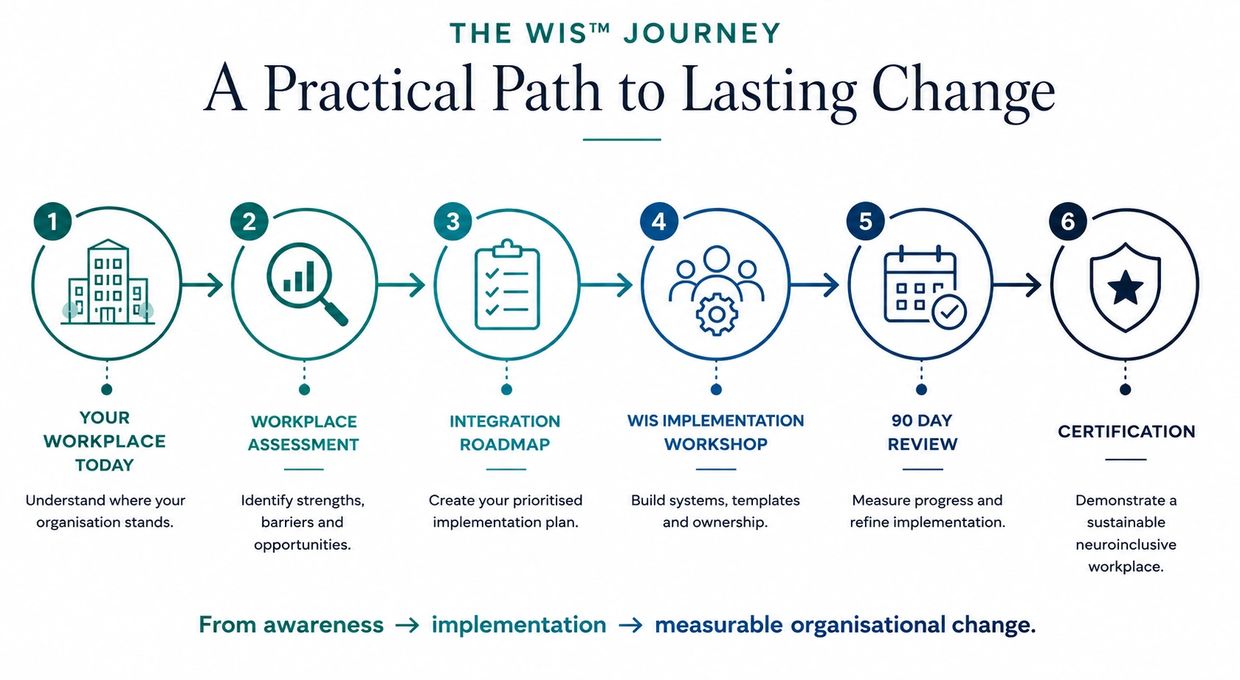
Every organisation starts in a different place. WIS provides a structured pathway from assessment through to sustainable implementation and certification.
implementing the Workplace Integration System™
Using our structured four-stage approach we help organisations move from awareness to sustainable workplace integration.
WIS is a full-day implementation session delivered to a small team from your organisation, typically your Neurodiversity Lead plus colleagues from management, HR, or wellbeing. The day moves through the system in sequence, with structured time for the team to begin completing each stage together, using real situations from your workplace.
By the end of the day, your team will have:
- A shared understanding of all nine WIS pillars and how they connect
- A first working draft across all nine stages
- A prioritised organisational roadmap, what to do first, who owns it, and what success looks like
- The confidence and materials to start using WIS internally from day one
Ways To Access WIS™ Integration Days
There are two ways to integrate WIS into your organisation:
- Attend a scheduled WIS™ Integration Day . Send a small team, typically your Neurodiversity Lead plus one to three colleagues from management, HR, or wellbeing, to one of our designated training days, run at a fixed location on a set date. Aftercare includes access to a monthly implementation clinic.
- Host an on-site WIS™ Integration Day. Bianca, delivers the full day implementation at your premises, ideal for training your whole team together, in the context of your own workplace. Aftercare includes a 30-day and 90-day implementation review.
Either way, the day ends with every organisation holding their own complete WIS Resource Folder, the nine-pillar WIS framework, the full-day agenda, and all nine fillable templates, ready to follow and put into practice straight away.
WIS™ Integration doesn't stop at the end of the day. Your Team leaves with everything they need to introduce WIS more widely: briefing line managers on the core principles, weaving the training into onboarding, building Workplace Barrier Audits into team reviews, and making sure adjustments are recorded consistently in HR systems.
Because more than one person shares the same framework and language, WIS is easier to embed consistently across the organisation, it isn't dependent on a single person remembering the details or carrying it alone.
Included in the consultancy package, is a 30-day and 90-day follow up session with me, to monitor implementation and effectiveness.
This is what makes WIS different from a one-off training session, it's designed to keep working long after the training day ends.
Bring WIF to Your Organisation
Whether you're a senior leader exploring options or a newly appointed Neurodiversity Lead, we'll talk through your organisation's needs and find the right fit for your team.
What's Included
- A full day of facilitator-led implementation, delivered by Bianca Ross or a trained WIS facilitator
- A complete WIS Resource Folder for each attendee to take away, covering attribution and use, the nine-pillar framework, the full-day agenda, and all nine fillable templates
- A working draft across all nine templates by the end of the day
- A prioritised organisational roadmap for embedding WIS
- Suitable for a small team of 2–4 attendees per organisation (e.g. Neurodiversity Lead, HR, line managers, wellbeing leads)
- Your choice of a scheduled WIS Training Day, or an on-site session at your premises
Investment
Open WIS Training Days
£400 + VAT per delegate (recommended for teams of 2–4)
Workplace Assessment
From £695 + VAT
WIS Implementation Workshop
From £4,000 + VAT
WIS Implementation Programme
From £7,500 + VAT
Every organisation is different. Most organisations use the Workplace Integration Assessment™ as the first step before implementing WIS™ across their organisation. Following a discovery call, we'll provide a tailored proposal based on your size, objectives and implementation requirements.